The Voting Rights Act

A Constitutional Commitment to Equality
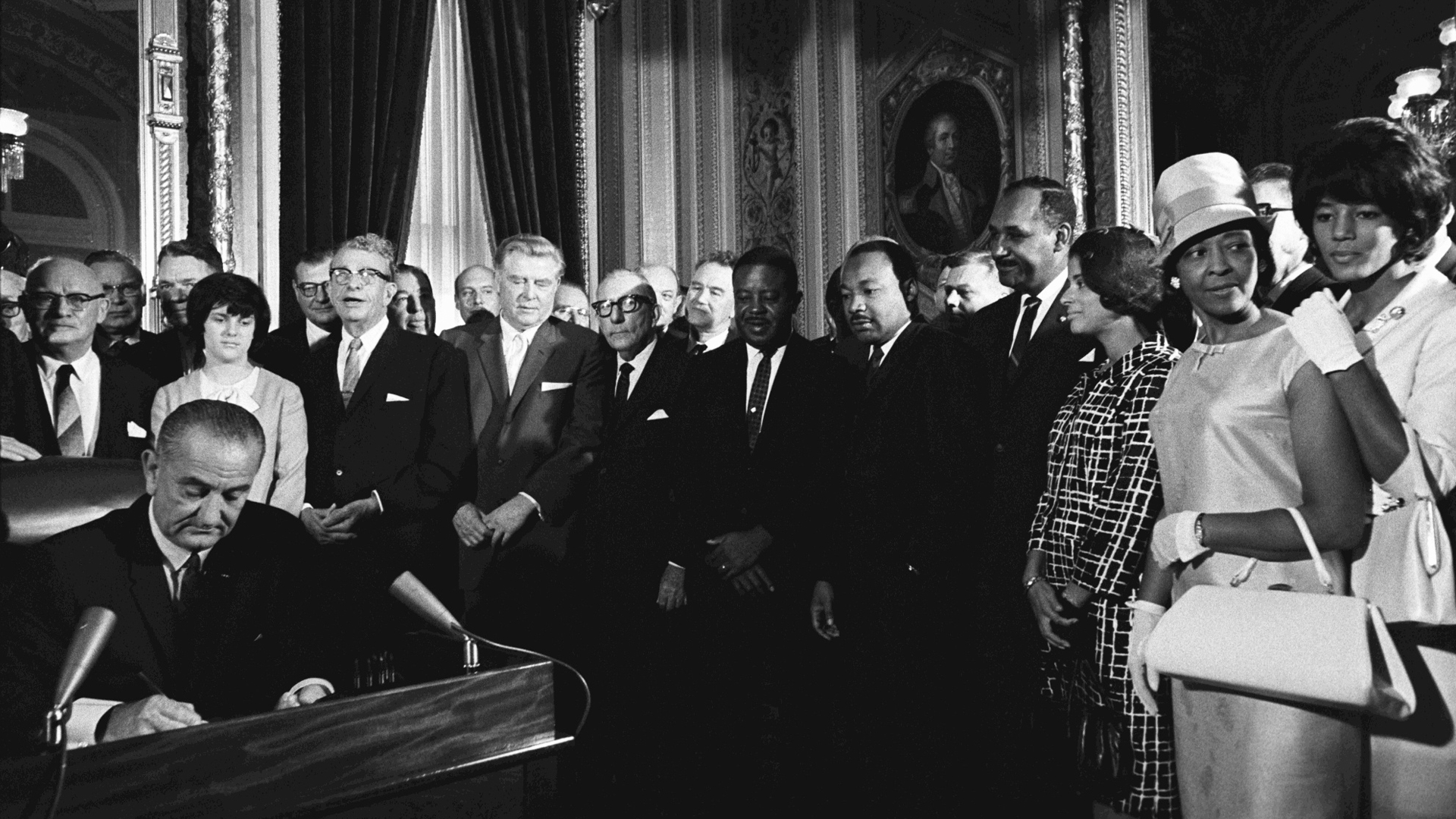
The Voting Rights Act of 1965 (VRA) is one of the most sweeping and consequential pieces of voting rights legislation in U.S. history. Signed into law by President Lyndon B. Johnson on August 6 1965, the bill was enacted to enforce the 15th Amendment’s guarantee of equal access to the ballot box regardless of race.
For decades, the Voting Rights Act has safeguarded the political power of minority communities through measures such as banning literacy tests and protecting against racial gerrymandering and vote dilution.
In recent years, however, the VRA has appeared at the center of a political and legal battle over American electoral policies. Key VRA protections have already been diminished and the future of this monumental legislation is increasingly uncertain.
A Turning Point in the Fight for Voting Rights
The Voting Rights Act is the product of years of activism by civil rights leaders.
March 1965 marked a decisive turning point for this movement. When peaceful demonstrators were brutally attacked by state troopers in Selma on what became known as “Bloody Sunday,” the violence shocked the nation and galvanized public support for voting rights. Within days, President Lyndon B. Johnson delivered a historic address to Congress calling for sweeping federal protections to secure equal access to the ballot box.
Just four months later, on August 6, 1965, that call culminated in the passage of the Voting Rights Act.
Key Provisions in the VRA
Two of the VRA’s most important protections are under Section 2 and Section 5 of the landmark bill.
Section 2 of the VRA helps enforce the 15th Amendment by giving voters the right to pursue legal action against racially discriminatory voting laws or practices. Citizens often use this to challenge electoral maps that weaken the voting strength of minority communities, also known as racial gerrymandering.
Section 5, meanwhile, required states and localities with histories of racial voter discrimination to obtain federal “pre-clearance” before implementing any changes to their electoral procedures. However, the Supreme Court’s 2013 decision in Shelby County v. Holder effectively dismantled Section 5, removing the pre-clearance requirement and weakening one of the VRA’s core protections.
The Supreme Court and the VRA
In 2013, in a 5–4 decision, the Supreme Court ruled that the formula used to determine which jurisdictions were subject to preclearance was unconstitutional. In the aftermath of the Shelby County v. Holder ruling, several states swiftly enacted restrictive voting laws that disproportionately impacted voters of color.
A decade later, the Court revisited the Voting Rights Act in Allen v. Milligan (2023), a landmark decision that upheld and enforced Section 2 of the VRA. The ruling required Alabama to redraw its congressional map to give Black voters an opportunity to elect representatives of their choice, reaffirming a critical precedent for future challenges.
The pending case Louisiana v. Callais (2025) will test Section 2 once again, as the Court weighs whether Louisiana’s congressional map unlawfully weakens the voting power of Black residents.
Our Continued Fight to Protect the VRA
Communities of color continue to drive the United States’ population growth, which is why protecting their rights is vital to a functioning democracy.
Despite current challenges, such as growing voter suppression efforts and increasing judicial hostility towards the VRA, there is still a path forward to restore the VRA’s full protections. Legislative efforts such as the John Lewis Voting Rights Advancement Act (JLVRAA) would strengthen the Act through congressional authority. Provisions in the bill include restoring the federal preclearance requirement and expanding protections against racial discrimination.
But passing this legislation, and defending the Voting Rights Act more broadly, depends on sustained public pressure and political engagement. The promise of equal access to the ballot will only endure if citizens demand it.
The time to act is now.
We are in an existential moment for our democracy — and we need the power of people like you. Are you in?